
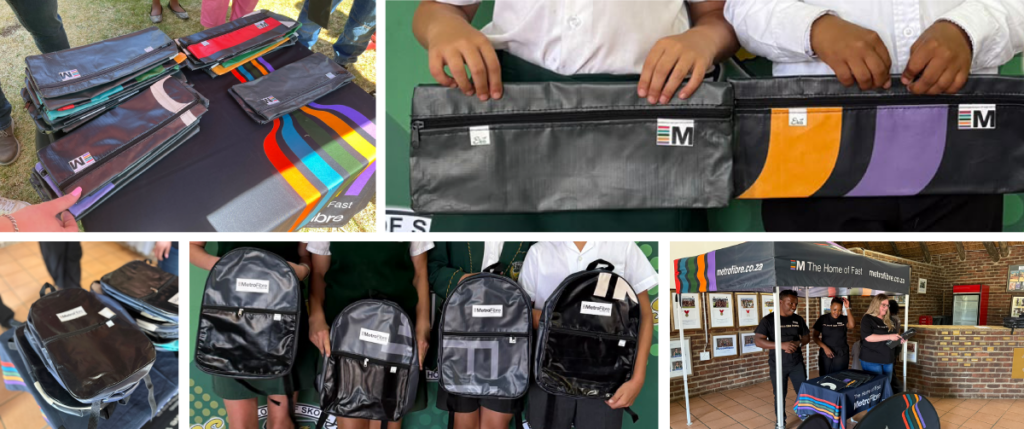
In an initiative that maximises both social and environmental impact, MetroFibre partnered with E’Yako Green to produce 1166 backpacks and 923 pencil cases from upcycled PVC banners.
Around 850kg or 1400sqm of PVC billboard material – enough to fill a quarter of a football field – was transformed into backpacks and pencil cases which were delivered to school children at eight schools and education centres across the country – Tlakula Secondary and Laerskool Fleur in Gauteng; Shakaskraal Primary and Isipingo Hills Primary in KZN; Charles Duna Primary and Frans Conradie Primary in the Eastern Cape; and Bloemhof Gekombineerde and Triest Training Centre in North-West Province.
E’Yako specialises in transforming marketing material waste into functional products, creating local employment opportunities while addressing environmental sustainability. Since its establishment in 2003 and its green product offering from 2011, E’Yako Green has created hundreds of job opportunities and successfully upcycled over 180 tonnes of billboard waste. The company operates on a model that partners with, mentors and capacitates small businesses to become part of its supply chain, fostering economic inclusion and environmental responsibility.
The initiative also demonstrates how businesses can rethink the lifecycle of their own marketing materials, moving from a traditional use-and-dispose model towards one where materials remain useful long after their original purpose has ended.
“What makes this initiative special is that a single investment creates impact in several ways. We’re giving learners something practical that supports their schooling, supporting local income generation, and giving material that would otherwise become waste an entirely new purpose.
And perhaps the most important part is the idea behind it. We want young people to see that sustainability isn’t only about waste. It’s also about creativity, entrepreneurship and seeing possibility in something other people might throw away,” explains Liza Kok, Chief Marketing Officer at MetroFibre.
Carey Moran from E’Yako Green highlighted the educational value embedded in their products: “We hope that our products inspire the learners who receive them. It’s not just a backpack or pencil case, but a window for the learners to start thinking about how they can contribute to a better environment and how seemingly unwanted, disposable goods can be upcycled and repurposed into functional products that earns them an income or lays the foundation for a small business. That’s the kind of critical thinking we hope to impart to every recipient of our products.”
What started life as advertising will now have a second life in classrooms and schoolyards across the country, carrying not only books and stationery, but a simple example of what can happen when waste is viewed differently.
Ends…