
For a small business, an internet connection is critical infrastructure. It runs the card machines, point-of-sale and the phones. It keeps the cloud accounting package live and the online meetings and client video calls stable. When it drops, trading stops.
When it comes to fibre connectivity for your small business, speed, reliability and price matter. But the question most owners skip is what happens when the line goes down. The answer depends on the type of fibre product you buy, and this is where many small businesses get it wrong.
Marcus Pawson, SMME National Sales Manager at MetroFibre unpacks the important considerations that every small business owner should consider in their fibre connectivity choice…
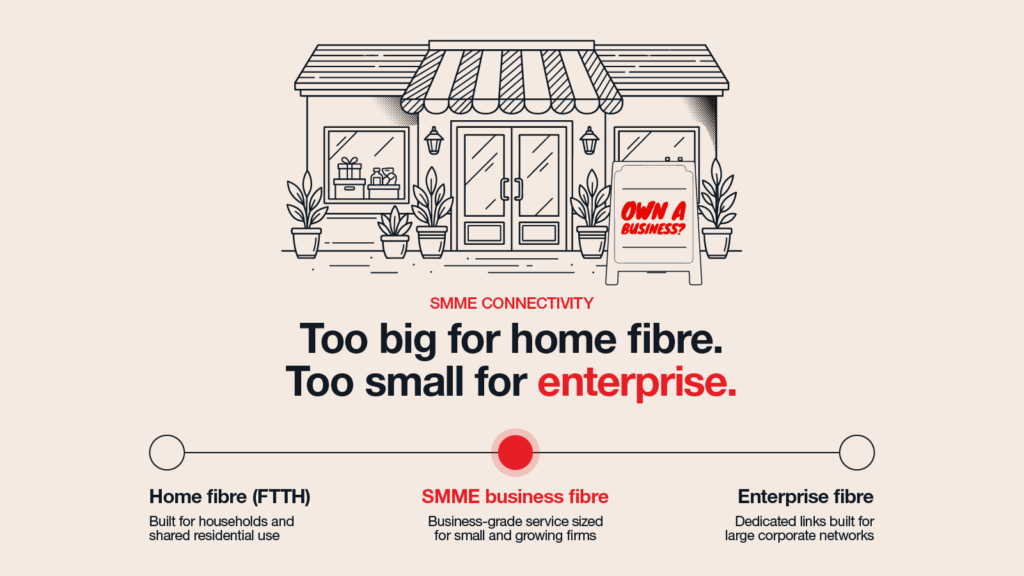
Too often, small businesses land at one of two extremes. Some run the business on a home fibre package that was never designed to carry it. Others sign up for an enterprise solution sized and priced for a corporate with hundreds of staff. Neither is a good fit.
Home fibre: fast, but built for households
Home fibre can be fast. The problem is everything around the line. Residential packages are designed for household use, and the support model is built around household needs. It is a very different story when your point of sale goes offline on a Friday afternoon, or clients can’t get through on the phones. Home fibre support is there around the clock, but it’s built around household needs. A business in that position needs service commitments designed around what downtime costs a business.
Enterprise fibre: capable, but often oversized
At the other end of the scale, enterprise connectivity is built for large organisations that simply cannot afford downtime. Dedicated bandwidth, tiered service level agreements and fast repair targets come as standard. So does the price tag. For a ten-person accounting practice or a single retail store, much of that is capacity and cover they will never use. Paying for it eats into margins that few small businesses can spare.
The middle ground: fibre sized for SMMEs
The right connectivity solution is determined by the nature, size and day-to-day demands of the business. For most small businesses, that means a product designed specifically for them. MetroFibre’s SMME Fibre solution keeps the parts of enterprise connectivity that matter to a small business and leaves out the overheads. Packages are uncapped, unthrottled and unshaped, on a low-contention network. That keeps VoIP calls clear and cloud applications responsive, even when the whole team is online.

Each connection includes a business grade Wi-Fi 6 fibre router as standard. There is also the option of a static public IP address, which is useful for remote access, VPNs and security systems. Support and service levels are where the difference really shows. SMME customers get business-grade support and a dedicated relationship manager. It is the kind of service a large corporate would expect, but without the corporate cost.
Speeds to match how you work
MetroFibre SMME packages range from 25 Mbps to 1 Gbps line speeds. Entry-level speeds suit businesses with light usage, such as email, web browsing and card payments. Higher tiers support busier offices with multiple users and devices, regular video conferencing and bandwidth-heavy applications.
Most packages are symmetrical, offering equal upload and download speeds up to 500/500 Mbps. Upload speed is often overlooked, yet it determines how quickly cloud backups run and how clear you look on a video call. This range is typically right for start-ups, retail sites and professional offices with fewer than 20 employees. An office needing staff Wi-Fi, VoIP telephony, guest hotspots and security tools can run it all on one uncapped business line, at a price that makes sense for its size.

Service commitments in writing
Every MetroFibre SMME connection is backed by a Business Service Level Agreement. It guarantees a minimum of 98% uptime per year and a maximum repair time of 24 business hours. Because fault-repair targets are documented, you know what to expect before something goes wrong rather than after. Affordable month-to-month contracts are also available on uncapped SMME packages, so there is no need to lock the business into a long-term commitment.
Why not just use LTE or 5G?
Some small businesses rely on mobile data as their main connection. It is quick to set up, but performance shifts with signal strength, network congestion and location. Towers can also struggle during power outages. The result is dropped calls, failed payments and frozen cloud applications at the worst possible moments.
It’s also incredibly expensive for data-intensive applications. Mobile data is charged per megabit, which gets prohibitively expensive with high usage and when multiple employees are online. It’s expensive and simply not sustainable or practical for your day-to-day and primary operations. Fibre delivers consistent, super-fast performance at a cost that is unmatched by any other connectivity solution.
The connection behind small business continuity
Small businesses are digitising fast. Cloud software, automated workflows, digital payments and AI tools are fast becoming part of everyday operations. Every one of them depends on the internet connection underneath. Choosing fibre is no longer just about speed. It is about matching the product to how your business actually works, and having the service and support you can reach when it counts. For most SMMEs, that is exactly what a dedicated small business fibre solution is built to deliver.
Ends…